Hebrews 11-12
August 21, 2022
Want to watch instead?This sermon's video
Outline
- The championship fight — "I lost, but I didn't get knocked out"
- The plan and the punch
- Who Hebrews was written to
One question
In that third round, both guys were spent and ready to coast — and then the music came up, the lights came on, and Toby said for once in his life he actually heard the crowd roar. When has somebody loud in your corner, at just the right moment, changed what you had left in the tank?
The whole sermon
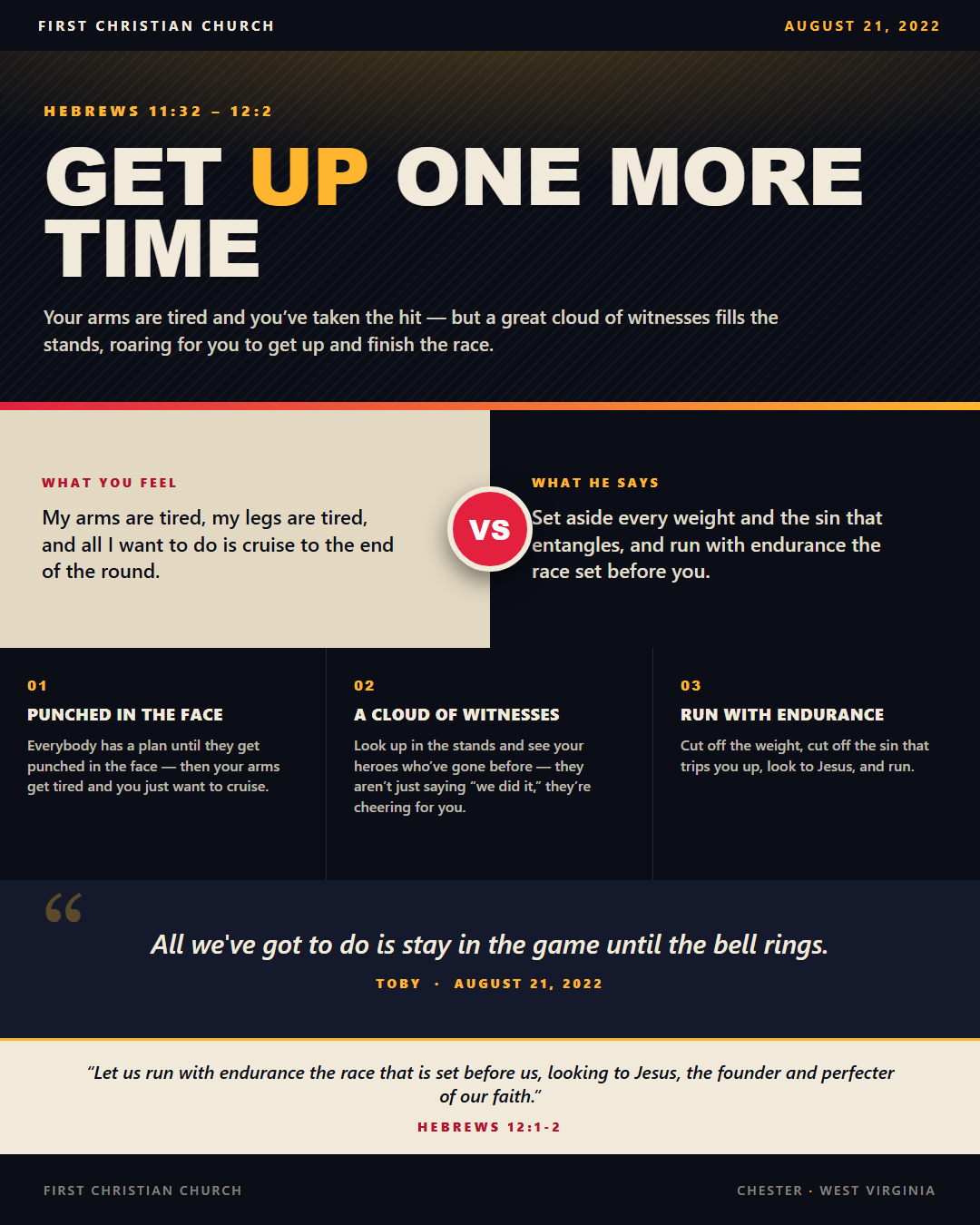
When you're too beat up to keep fighting and just want to coast to the bell, a stadium full of the faithful who went before you is on its feet cheering for you by name — so get up for one more round.
Central Image
The third round of the 2001 Houston Tough Man Contest — two exhausted fighters ready to cruise until the Rocky music and the roaring crowd made them empty the tank — standing in for the great cloud of witnesses in the stands.
The Turn
You figured the joy set before you and a solid plan were enough fuel — but "everybody has a plan until they get punched in the face," and what the plan never covered was the crowd behind you, cheering, for the moment you're too hit to want to go on.
Outline
The championship fight — "I lost, but I didn't get knocked out"
Toby's whole plan against Ben Dillon — who'd flattened every opponent in under 40 seconds — was just not to get knocked out. He lost the first two rounds and counted it a win. In round three both men were spent and ready to coast, until the owner cranked the Rocky music, threw up the lights, and the crowd roared, and the two of them fought like Rocky and Apollo to the bell.
The plan and the punch
Recapping the series — the joy set before us (the why) and a pattern for walking it out (the how) — Toby landed on Tyson's line: everybody has a plan until they get punched in the face. You can have the joy and the plan and still, once you're hit and tired, just want to keep your hands up and cruise. We need a contingency for that exact moment.
Who Hebrews was written to
These were Jewish Christians getting cancelled for Jesus — losing jobs and business, cut off from family dinners, kicked out of the synagogue, called fools and traitors, with bloodshed probably still down the road. They were tired. As Toby put it: somebody's got to tell me I'm doing good when I feel bad.
By faith — losers or heroes
The writer answers by stacking up the heroes: by faith, by faith, by faith. These were educated Greek-speaking Jews who knew the Greeks and Romans mocked faith as the stuff of rubes and rednecks and called logic and strength the real virtues. But Abel gave an offering by faith and got murdered by his own brother — loser or hero? The world calls faith-people losers; the truth is the world was unworthy of them.
The great cloud of witnesses
"Surrounded by such a great cloud of witnesses" is stadium language — you're on the 50-yard line, and your heroes are up in the stands, not just saying "we did it" but cheering for you. So cut the weight, cut the sin that trips you up ("cut that turtle off and get him out of the boat"), look to Jesus, and run.
Jesus endured the cross
Jesus is a step above the rest — the author and perfecter of faith. He didn't suffer the cross, he endured it, the way a marathoner endures the marathon and a mountain climber endures the mountain, winning through it. He despised its shame and ended up seated at the right hand of God, the most honorable place a person could hold.
Puddin and Mammy — the everyday heroes who cheer
The cloud isn't only Bible heroes. Toby has no grandmothers — he has a Puddin and a Mammy, who both prayed him into preaching. Puddin's gone on now, and he thinks of her every time he fries taters in her old iron kettle. She never killed a lion in a snowy pit, but she lived faithfully and cheered for him, and that's what makes her a hero — and people in the room named theirs out loud, down to Laura Mae Wade.
The vision — everyday heroes
Asked his vision for the church, Toby wanted a people with the joy in front of them and the encouragement behind them, who cheer each other on and know they're cheered from glory. Most of us will never fight a literal giant; we live mundane lives. But by faith you can be a hero inside an ordinary life — and remember somebody's cheering for you.
The Landing
Before lunch is over, tell somebody the name of a person in glory who's cheering for you — and when you get punched and just want to cruise, listen for what Max Lucado called the applause of heaven and get up one more time, because we've already won; we just have to stay in until the bell rings.
Questions to Think About
- In that third round, both guys were spent and ready to coast — and then the music came up, the lights came on, and Toby said for once in his life he actually heard the crowd roar. When has somebody loud in your corner, at just the right moment, changed what you had left in the tank?
- Toby spent real time on who the book of Hebrews was written to — people losing jobs, business, family dinners, and their place in the synagogue for following Jesus. What did he say they needed to hear besides "Jesus is the only way"?
- Toby called "the world was not worthy of them" the peak of the whole passage. For people whose own families were calling them losers and traitors, why would that one line land so hard?
- Toby described round three exactly — not quitting, not leaving the ring, just wanting to keep your hands up and cruise to the bell. Where in your life are you cruising like that right now?
- "Everybody has a plan until they get punched in the face." What was a punch that made you want to back away from something you'd set out to do with God?
- Toby's cheering section was Puddin and Mammy, who prayed him into preaching. But for some people, family was the punch, not the crowd. If you can't picture anybody in the stands on their feet for you, what does this sermon actually have for you?
- Toby's vision was a church that cheers each other on and turns ordinary people into everyday heroes. Where are we actually cheering one another on here, and where are we just sitting quiet in the stands?
- Toby wanted people to do it before lunch was even over — say out loud to somebody the name of a person in glory who's cheering for them. Who are you going to say that name to this week?