Ephesians 6:1-4
November 27, 2022
Want to watch instead?This sermon's video
Outline
- The Landing
One question
Before Toby made his big point, he had everybody in the room check whether they were holding an iPhone or an Android. Thinking back on how you were raised, what's one thing your parents "installed" in you early that you still catch yourself running today?
The whole sermon
We don't make kids step up so they'll belong — we tell them they already belong to the Lord, and that belonging is what frees them to step up.
Central Image
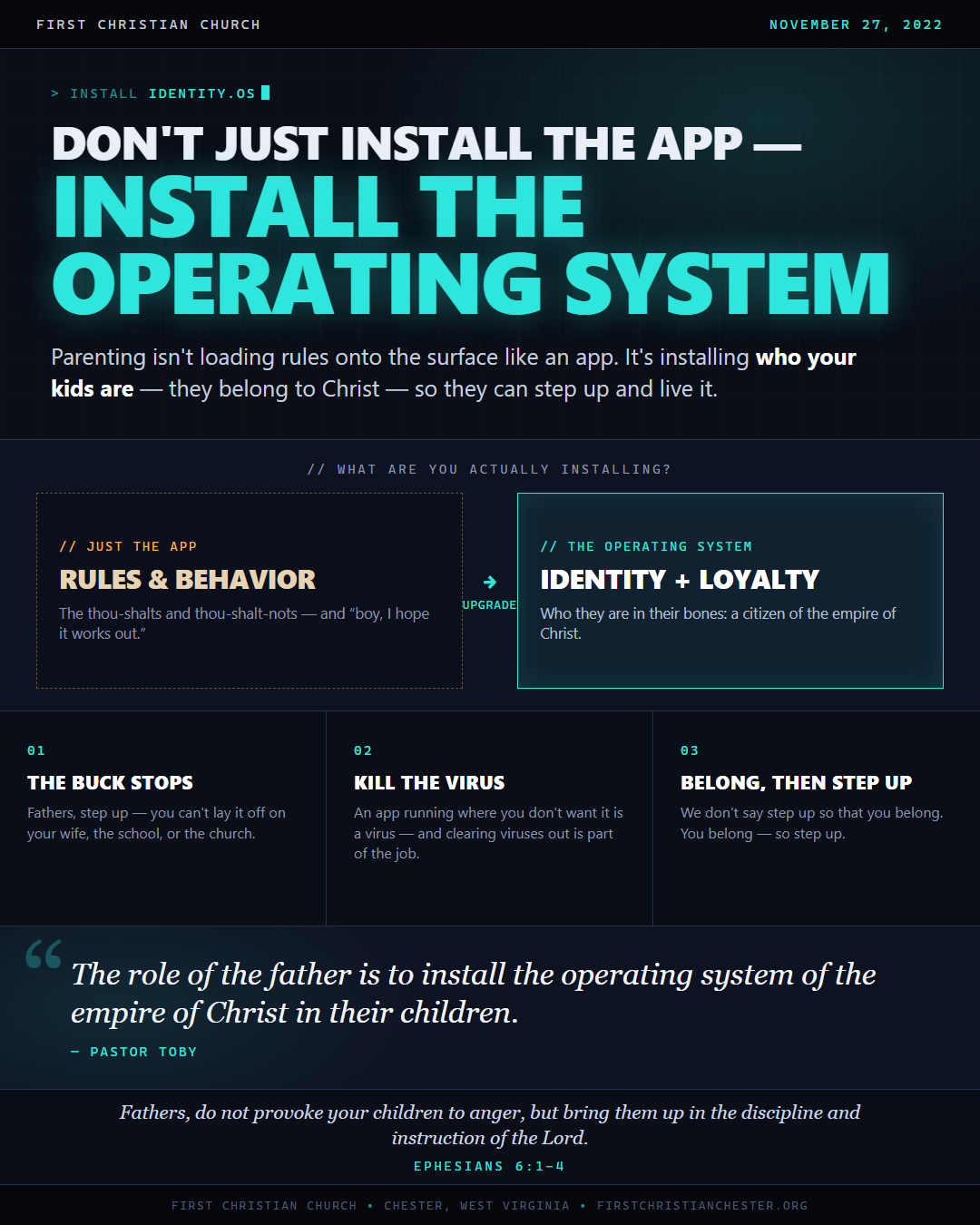
The operating system versus the apps: raising a child isn't loading a few good habits on like a Spotify app, it's installing the whole operating system of who they are — and the father's job is to install the identity of a citizen of the empire of Christ.
The Turn
Everyone expected Paul to address the man of the house first and tell kids not to provoke *him*; instead Paul takes a stick to the whole arrangement — he speaks to the children first, as real people who already belong, and tells the fathers not to provoke *them*.
Outline
Splitting the sermon. Toby opened by confessing Missy was right — Ephesians 6:1–4 won't fit in one sermon — so the slaves half waits till next week, and all the "cutesy things and illustrations" with it. He said he'd talk to the room, not preach at it, and asked them to carry him. The whole thing ran stripped down and honest from there.
Fathers first — the buck stops with you. He preached it out of order on purpose, starting with fathers. In the Greco-Roman world the father was the one more likely to read, so teaching fell to him; Paul's deeper point is that the buck stops there. You can't lay it off on your wife, the school, or the grandparents. Step up.
"Don't provoke your children" — Paul with a big stick. Toby made Paul into Buford Pusser from *Walking Tall*, swinging a stick at Roman convention. The Roman dad expected the reverse — the kids shouldn't provoke *him*. And in the Old Testament, "provoke to wrath" is what Israel did to God. Paul turns that word on the father and shrinks what his discipline is allowed to look like.
Nourish them — installing the operating system. "Nourish" is the same word Paul used for how a man cares for his own body. Then the central image: education isn't installing an app, it's installing the operating system. Rome's OS was identity and loyalty — knowing where you fit in the hierarchy under Caesar. The father's job is a bigger citizenship: a kid who knows in their bones they belong to the empire of Christ and are loyal to him first.
You're not alone, but the buck still stops. The good news: you've got the Holy Spirit, the Word, and the whole church (Ephesians 4) to come alongside you. The bad news for excuses: you still can't hand it off. "Church didn't do it, school didn't do it, grandparents didn't do it" — none of that flies. Step up.
Weeds, viruses, and "I was wrong." A weed is just a plant growing where you don't want it — St. Augustine grass is fine in the yard and a weed in the cornfield. Cancer is growth in your body you don't want; a virus is an app on your OS you don't want. Part of parenting is pulling those weeds and cleaning those viruses out of a kid's mind — and sometimes admitting the bad one came from us. Being able to say "I messed up" is exactly what wins the trust to be believed later. The parent who's never wrong is, as the kids say, "sus."
Training is coaching. "Admonition" is mostly coaching, not punishment. The Mandy basketball story carried it: close your eyes, picture the perfect shot from the outside like a movie, then picture yourself making it — and all the corrections come home. You don't hand a kid the rights and wrongs and just hope; you coach them through it.
Back to the children — "in the Lord." "In the Lord" attaches to *obey*: kids obey because they belong to the Lord first. Paul addresses children first and directly — unheard of in Rome, where you'd speak to the paterfamilias and never the kid — treating a child as a real moral agent. It's "children," not "sons." And "this is right" means *righteous* — a five-year-old can do something righteous.
The promise, made personal. "First commandment with a promise... that it may be well with you." The puzzle: obedient kids die young, rebels live to 80. Toby's answer — it's a promise to *you*, not a comparison with anybody else. It will be better for you over the long haul if you obey than if you don't. A hundred percent, every time. Stop comparing and own the promise for your own life.
You belong — "step up because you belong." God lays claim to the children. Goethe: treat a man as he is and he stays as he is; treat him as he ought to be and could be, and he becomes it. The church names where a kid actually is while calling them higher, installing the identity "I am a child of God." Then the turn he pressed hardest: step up *because* you belong — don't step up *to* belong. That second one is legalism and the path of craziness. (The screen on its way, provided by folks who "stepped up," was a live example.)
Bryson. Toby called a little boy up front and walked the whole sermon in miniature — Do you know Jesus? Did he die for your sins and rise again? Do you want to do what God wants, starting with obeying and loving your mom and dad? He pointed back to Bryson's dad getting baptized in the creek a few weeks back and promised Bryson his own day in the water. "I asked him where he was. I told him who he was. And one day he's going to step up."
The Landing
We as parents and as church live and work together to hand kids that identity — you're family, you're us, you belong — so step up. And that's exactly how God parents us: he shows his goodness, calls us his own, puts his Spirit in us so we never have to wonder who we are, then says "you're mine, so you've got everything you need to step up."
Questions to Think About
- Before Toby made his big point, he had everybody in the room check whether they were holding an iPhone or an Android. Thinking back on how you were raised, what's one thing your parents "installed" in you early that you still catch yourself running today?
- Toby said Paul "turned the apple cart over" when he told fathers not to provoke their children to anger — because the Roman dad expected the exact opposite. Why would that one line have landed as such an insult in Paul's world?
- Toby drew a hard line between installing an app like Spotify and installing a whole operating system. What did he say Rome's "operating system" was really about?
- Toby said the buck stops with the father — it can't get laid off on anybody else. Where are you most tempted to hand the operating-system job off to someone else: your spouse, the school, the grandparents, the church?
- Toby said being able to say "I was wrong, I messed up" is what earns you the right to be believed later when you tell a kid something out in the world is wrong. What makes that sentence so hard to actually say to your own kids?
- Toby was confident that even a kid who walks away will know, in their bones, that they're walking away from something real. If you've got a grown child who's gone, does that certainty comfort you or does it sting — and why?
- Toby said no parent is meant to do this alone — the whole church is the support structure. Whose kids in this room are we quietly leaving their parents to raise by themselves?
- Pick one kid this week — yours, a grandkid, a kid at church — and tell them straight out that they belong here and they're the Lord's, before you ask them for a single thing. Who's the kid, and when are you doing it?