1 Samuel 14
September 1, 2024
Want to watch instead?This sermon's video
Outline
- The Landing
One question
Toby's friend Dustin rounded the corner at the mall and told the guy, "I handle all your light work." Who's someone you've just been plain glad to see show up when things were about to go bad for you?
The whole sermon
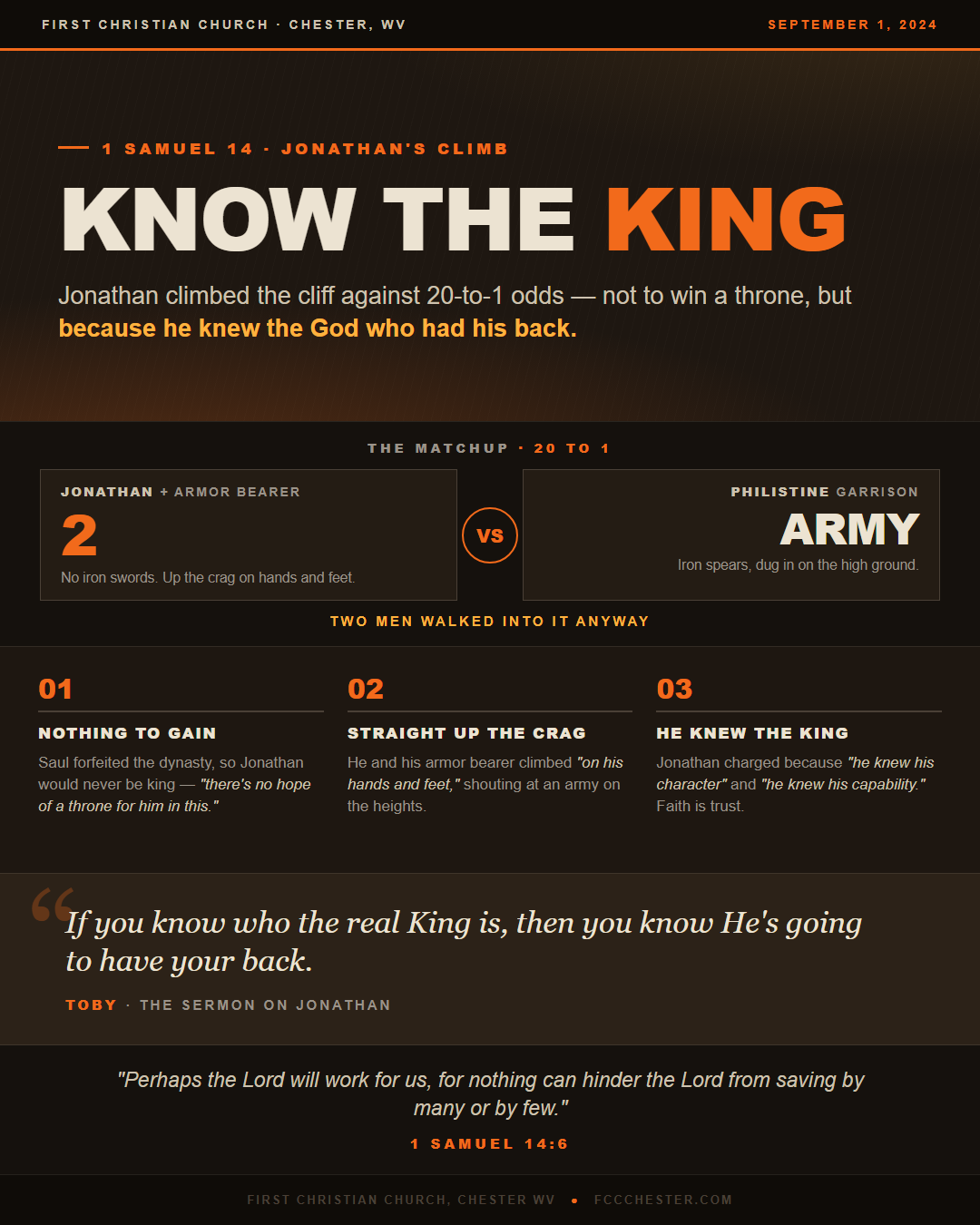
Jonathan took on a Philistine army with one teenage armor bearer because he knew who the real King was — and faith is nothing fancier than knowing someone's character and capability well enough to act on it.
Central Image
Jonathan and his armor bearer climbing the rocky pass on their hands and feet toward a whole garrison — a man acting on who he knows God to be before he has any idea how it turns out.
The Turn
We assume Jonathan was a one-man action hero who was simply that good; the pool-noodles-against-eight-foot-spears bit exposed that as movie fiction — what happened was a flat-out miracle, and what drove it was Jonathan knowing the King, not Jonathan's nerve.
Outline
"I just want to give Jonathan his day in the sun"
Toby set aside the obvious Saul-versus-Jonathan contrast on purpose — no holding the two up side by side so Saul looks bad. He wanted Jonathan by himself. Jonathan's the one who got the shaft: next in line for the throne until Saul lost the dynasty, and he never comes out bitter or angry at God. He stays loyal, stays after God, and later treats David — the man taking the throne he'd have had — like a brother.
"Perhaps the LORD will work for us"
Israel has almost no metal weapons, Saul is holed up under the pomegranate tree with 600 men and a priest from Eli's doomed line, and Jonathan quietly takes his 20-year-old armor bearer off to the garrison without telling his dad. Two crags, named in Hebrew "slippery" and "thorny," with the enemy up top. Jonathan's word is "perhaps" — nothing can hinder the Lord from saving by many or by few, but God still gets to decide how it goes. The armor bearer is all in: "I am with you, heart and soul."
Not an action movie — a miracle
Jonathan climbs up on hands and feet; the armor bearer comes behind finishing off the men Jonathan strikes down — brutal, close, Iron-Age work, twenty dead in the space of this room. Then the noodles: we read this through Schwarzenegger and Statham, but eight real soldiers with eight-foot spears who want to kill you means one lick lands and it's over. Toby's point — what happened was as much a miracle as any of the overt ones in the Bible. God scrambled them until they were "melting," killing each other, before Saul ever came up.
"He saved Israel because he knew who the king really was — and it wasn't Saul"
All through the chapter Saul is "him, him, him" — his honor, his enemies, his standing. Jonathan has no throne to win and nothing to gain; by human math, climbing that hill is suicide. The only reason a man does that is if he knows the King — his character and his capability. Toby points to S.M. Lockridge's "My King" and to the three men at the furnace: "perhaps He will, perhaps He won't — either way we're not bowing."
The mall, and what faith actually is
Cornered at the mall by a guy who wanted to leave him in an ambulance, Toby's already doing the math on how to run — until his friend Dustin rounds the corner, ignores the guy completely, and says, "Toby, what have I told you? I handle all your light work." The moment Toby saw who had his back, he quit trying to save himself and could even laugh. That's the definition: faith isn't a magic feeling, it's knowing somebody's character and what they can do and trusting them.
Knowing about Him vs. knowing Him
Jonathan never held a Bible — it wasn't around — but he knew the stories and had lived them, and that's what sent him up the hill. We do have one. And yes, knowing about God isn't the same as knowing Him — but when Toby was crazy about Missy he grilled her with a whole Book of Questions because he wanted to know everything. So: the NIV Chronological Bible is in the pews, the plan starts Monday, two days' readings a day, five days a week, audio recorded, every barrier pulled out of the way.
A church full of giant killers
Jonathan's boldness was catching — David caught it, and a whole culture of giant killers grew up around David. That spread is the actual agenda behind the reading plan. Picture the man passed over for the promotion who'd be smart to go find another job; Jonathan instead doubles down on his duty, because nothing in his circumstances changed the fact that he was still a son of the real King, and he acted like it until the day he died.
The Landing
Get to know Him yourself — through His Word — and you'll stop working your own escape route and go, because you'll know who has your back. "Oh, for a church of giant killers."
Questions to Think About
- Toby's friend Dustin rounded the corner at the mall and told the guy, "I handle all your light work." Who's someone you've just been plain glad to see show up when things were about to go bad for you?
- Toby made a point of not running the usual Saul-versus-Jonathan comparison — he said he only wanted to give Jonathan his day in the sun. Jonathan lost the throne he was in line for because of his dad and never turned bitter. How did the sermon say he handled that, especially once David came along?
- Jonathan said, "Perhaps the LORD will work for us — nothing can hinder the LORD from saving by many or by few." Toby made a lot of that word "perhaps." What did he say it was doing in Jonathan's mouth?
- Toby said he quit trying to save himself the second he saw who had his back. Where are you still working your own escape route instead of trusting the One who's actually got you?
- Jonathan climbed that hill with no throne coming to him and nothing to gain for himself. Where are you only willing to step out if you can see what's in it for you?
- Toby said Jonathan was ready to climb that hill and die if it came to that — "perhaps He will, perhaps He won't." We love the half where it works. Could you say the "perhaps He won't" half out loud and still go?
- Toby said his whole agenda is a church full of giant killers, and that the boldness is catching — it jumped from Jonathan to David to a whole generation. What are we as a church too careful about for that to catch on here?
- The chronological Bibles are in the pews and the plan starts Monday — two days' readings a day, five days a week. When in your actual day is that going to happen, realistically?