Luke 7:18-35
February 16, 2025
Outline
- The Landing
One question
Toby opened with his old Greek professor, Tom Geer, who told a room of students that knowing Greek would never hand them the answers — at best it would help them ask better questions. When has a better question gotten you somewhere that chasing a quick answer never did?
The whole sermon
Either Jesus is everything or he's just one more thing — and "are you the one, or should we wait for another" is a question you still have to answer about your own life.
Central Image
The health-insurance supplement — the little add-on you buy on the side — standing in for everything we reach for to fill what we won't quite trust Jesus to fill.
The Turn
We hear John's question as a dying man's doubt; Toby overturns it — the man who saw the heavens torn open and named Jesus the Lamb of God wasn't doubting, he was trusting Jesus enough to ask whether he was also the king, not only the one who suffers and dies.
Outline
Ask a better question
Toby started with his professor Tom Geer, who told a room of second-year Greek students that the language would never hand them all the answers — if they did it right, it would help them ask better questions. Lousy questions get lousy answers. He hung the whole sermon on that line: John the Baptist asked a far better question than he usually gets credit for.
They'll find any reason
Reading Luke 7, he landed on the children in the marketplace — we played the flute and you wouldn't dance, we sang a dirge and you wouldn't cry. John came fasting and they said he had a demon; Jesus came eating and drinking and they called him a glutton and a drunk. The crowd that rejects God's messengers finds a reason no matter what, because it was never about the evidence.
Don't tell him — show him
John's men ask Jesus flat out, "are you the one who is to come?" Jesus won't just say yes — he tells them to go report what they've seen: the blind see, the lame walk, the lepers are cleansed, the good news is preached to the poor. Toby's take: I can tell you somebody's great all day, but it lands harder when I show you — and John will know exactly how to read that list.
A detour on "soft clothing"
He paused on Jesus's crack about the wilderness — what did you go out to see, a man in fine clothing? That Greek word, Toby said, is the same one used for an effeminate man, so Jesus is painting the powerful types who sneered at John as dandies decked out like Liberace, while John stood there in camel's hair and locusts as their flat opposite — with a quiet jab that there's something unmanly about rejecting him.
John wasn't doubting
The usual reading says John, locked up and facing Herod, is losing his nerve. Toby waves it off: six to eighteen months earlier John watched the heavens tear open at the baptism, saw the Spirit come down, heard the voice boom from heaven — and he's the one who called Jesus the Lamb of God who takes away the sin of the world. That sticks. The madman in the wilderness was sure.
One Messiah or two?
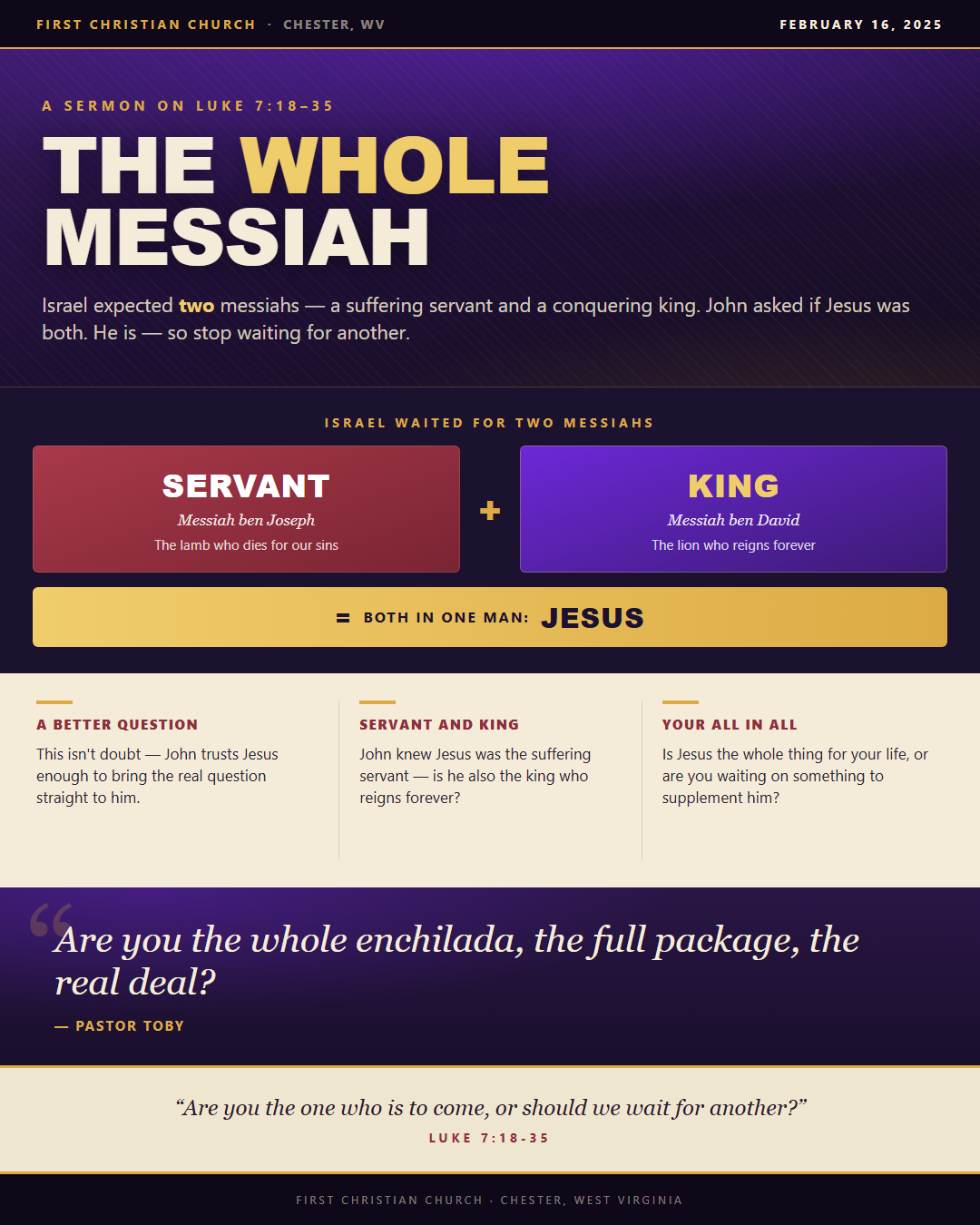
So what's the question really about? In the first century nobody was certain the "one who is to come" was a single man — some looked for two, Messiah ben Joseph, the suffering, atoning servant, and Messiah ben David, the king who reigns forever. John already knew Jesus was the suffering servant; what he couldn't tell was whether Jesus was also the king, since Jesus wasn't raising an army or threatening Rome. (An aside Toby enjoyed: Jesus is the son of David whose earthly father was named Joseph — both in one man.)
Ask the man himself
John doesn't send his question to anyone else — he sends it straight to Jesus. Toby's picture: if you want to know whether Jeff is the best contractor for the job, asking Jeff himself first means you trust him to tell you straight. John trusts Jesus enough to ask "are you both?" and to take the answer — even though what Jesus is doing matches no one's picture of the conquering king. Jesus's reply, look at what's happening, means yes, both: the one who heals and the one who conquers, just not the way they expected.
Are you the one, or do I wait for another?
Then Toby turned it on the room. This is the question every one of us keeps having to ask: is Jesus the whole thing, or just a thing? He died for my sins — fine — but is he also the king of my life, or do I keep a few areas on my own terms and treat him like a supplement bought on the side? He owned it himself: he's taken notes and had words with the Lord about how things ought to be run — and it turns out he's not God, and he's okay with God being God.
The Landing
Stop waiting for another, and stop shopping for something on the side to fill what only Jesus fills — take him as everything, all in all, even when he runs things in a way you wouldn't have chosen.
Questions to Think About
- Toby opened with his old Greek professor, Tom Geer, who told a room of students that knowing Greek would never hand them the answers — at best it would help them ask better questions. When has a better question gotten you somewhere that chasing a quick answer never did?
- Toby insisted John wasn't doubting when he sent word from prison, pointing back to John watching the heavens tear open at the baptism and calling Jesus the Lamb of God. Does that reading of "are you the one, or should we wait for another" convince you, or does it still sound like a man starting to wonder?
- Toby split the first-century hope into two figures — the suffering servant who dies and the king who reigns forever — and said John knew Jesus was the first but couldn't yet tell if he was the second. Why would it be so hard to believe one man could be both?
- Toby asked whether Jesus is your whole policy or just the add-on supplement you buy on the side. Where in your life are you treating Jesus as the add-on?
- He drew a line between Jesus as the one who died for your sins and Jesus as the king of your life. What's one area you still keep defined on your own terms instead of his?
- Jesus ended his answer with "blessed is the one who is not scandalized by me." Where is Jesus not being the Jesus you wanted him to be — where are you quietly offended at how he's running your life?
- Toby ran the question all the way down to "how you should do church" and "how you should feel about being here." Where might we, as a church, be waiting for another — counting on some program or personality to do what we're not trusting Jesus to do among us?
- This week, pick the one "add-on" you've been using to fill what only Jesus should, and tell one person in this room what it is — out loud, by name.