Judges 3
July 6, 2025
Want to watch instead?This sermon's video
Outline
- Learning on the easy one
- It starts with forgetting
- You're going to serve something
One question
Caleb promised his daughter to whoever could capture Kiriath-Sephir, and Toby asked whether that was really a smart way to pick a godly son-in-law — but it worked out, and Othniel turned out to be the real thing. What's a risk in your own life that turned out better than it had any right to?
The whole sermon
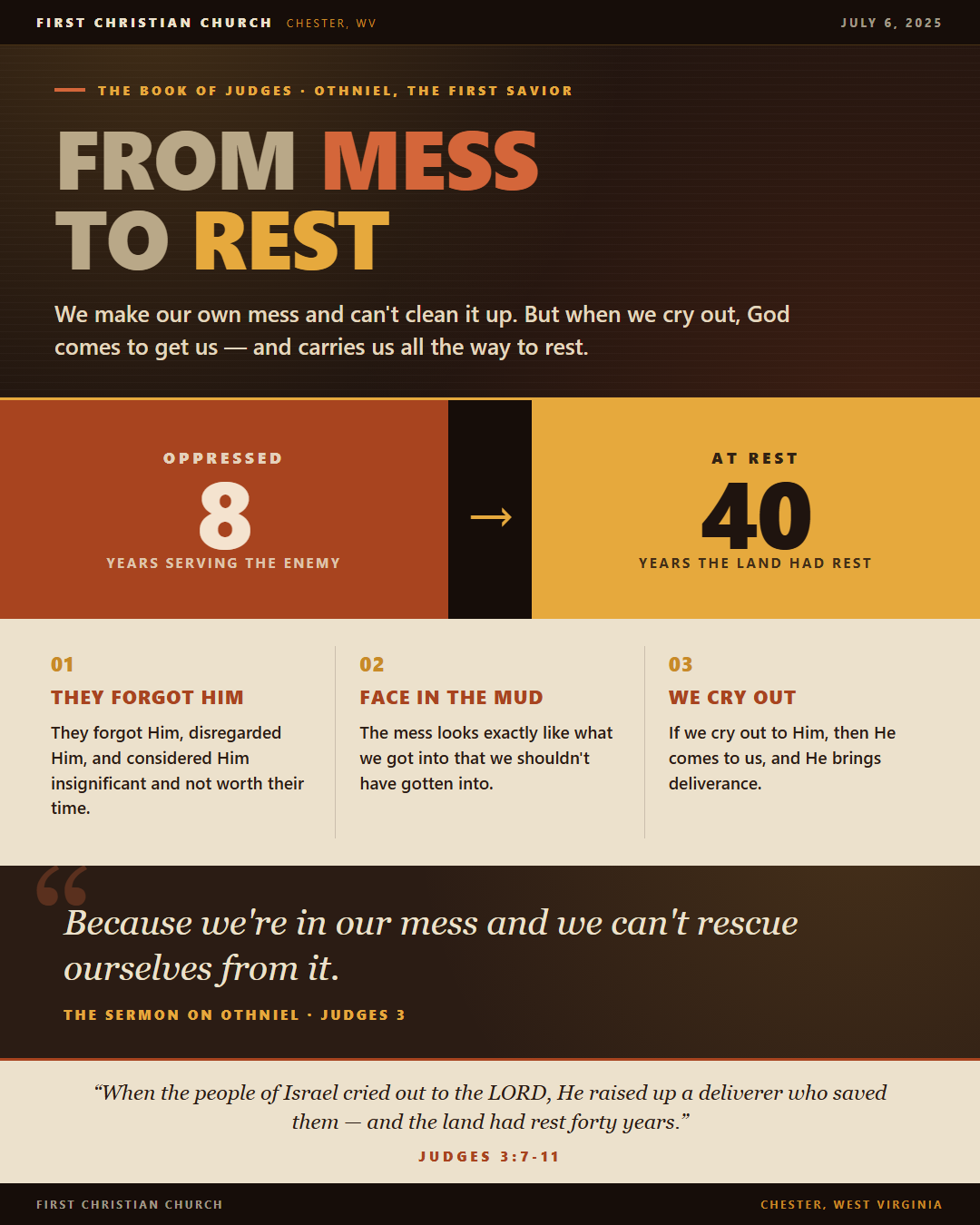
You can't pull yourself out of the mud you chased your way into — but cry out, even badly, and the Savior comes and gets you and gives you rest.
Central Image
The kid with chocolate all over his face from the cookie jar: the mess we end up in looks exactly like the thing we were reaching for, and we can't wipe it off ourselves.
The Turn
We assume drifting from God starts with some dramatic, wacky sin — but Othniel's cycle shows it starts with forgetting Him, disregarding Him as not worth our time.
Outline
Learning on the easy one
Othniel is the first of the two ideal judges, and his story (Judges 3:7–11) is told compactly so the pattern is easy to see — evil, the Lord's anger, oppression, crying out, a savior, rest. Toby set him up through Caleb's gamble back in Joshua: give my daughter to whoever takes Kiriath-Sephir. It was a risk, and it landed — Othniel turned out to be the real thing.
It starts with forgetting
The evil wasn't the wacky sin we'd expect first; it was that Israel forgot the Lord. Forgetting here isn't amnesia — it's Kevin telling the trooper he "forgot" there was a speed limit while doing 90. They cared so little for Yahweh they disregarded Him as not worth their time. In the story only God and His people have real names; everything else is just a thing — and they traded a personal God for things that are only things.
You're going to serve something
They didn't forget Yahweh and then serve nothing — they served the Baals and the Asherahs, because you're always going to serve something. So God gave them what they wanted: you want to serve? Then you'll actually serve. He sold them to Cushan-Rishathaim for eight years — long enough to make them hate it.
They cried out — they didn't repent
When it got bad enough, Israel cried out. Toby noted it never says they repented — not here, maybe nowhere in Judges. Crying out is hating the consequences; repenting is being different. God had mercy anyway and raised up a savior.
Whose hand saved them? Yes.
The Spirit of the Lord came on Othniel and he judged Israel — a real Bronze Age judge who both settled disputes and led in war, and whose reach covered the whole nation, south to north. The text says God gave the enemy into his hand and his hand prevailed. Whose hand saved them, God's or Othniel's? Yes — God saves through people, and when we really do it, He's the one doing it through us.
The double wicked Cushite and the land of the double river
Cushan-Rishathaim isn't a birth name — the book of Judges named him "double wicked Cushite" to tell us what he was and to wipe his real name out of history. He came from Aram-Naharaim, the land of the double river, Mesopotamia — home of the Kassites, the one real functioning empire of the whole Judges period and Israel's most dangerous enemy. And it took exactly one judge from the bottom of the map to topple it. But it's also a warning: when Israel later refused to seek God, a worse beast grew in that same land of the double river — Babylon — and that time there was no deliverer.
He saved them — and the Lion of Judah
"The Lord raised up a savior... he saved them" is the literal center of the story in Hebrew; everything balances around it. And Othniel reads like a sketch of Jesus: his name means Lion of God, he's from the tribe of Judah, a savior who saved his people, anointed by the Spirit, a favored son who left home to defeat the empire of this world. Every judge is telling us something about Christ, because it's all Him — the Lion of the tribe of Judah who alone was worthy to open the scroll (Revelation 5:5).
Face-down in the mud, and the cry that brings rest
This is the model for the whole book: we mess up, and we land face-down in mud that looks exactly like what we chased. We can't clean ourselves off — we're the two-year-old smearing the chocolate around worse — and Israel couldn't kick Cushan-Rishathaim out themselves. But if we look up and cry out, even imperfectly, He comes and gets us; He doesn't tell us to come to Him, He comes to us. Toby got personal here — whatever his own body does from here, "I'm His, wherever it goes" — and tied it to Hebrews' rest for the people of God: delivered, washed off, given a firm place to stand.
The Landing
Receive the rest God has already given you in Christ — not sitting-still rest, but being at rest in the middle of the hard thing — and then let people watch you carry it that way.
Questions to Think About
- Caleb promised his daughter to whoever could capture Kiriath-Sephir, and Toby asked whether that was really a smart way to pick a godly son-in-law — but it worked out, and Othniel turned out to be the real thing. What's a risk in your own life that turned out better than it had any right to?
- Toby said we picture going off the rails as diving headfirst into whatever we think the worst sins are — but the text says Israel's trouble started with forgetting God, the way Kevin "forgot" there was a speed limit while doing 90. What's the difference between those two pictures of how a person drifts?
- Toby lined Othniel up next to Jesus point for point — the Lion of God, from the tribe of Judah, a savior who saved his people, anointed by the Spirit, a favored son who left home to take on the empire of this world. Does seeing Jesus in a story like Othniel's open up the Old Testament for you, or does it feel like a stretch?
- Toby said the mess we land in usually looks exactly like the thing we were reaching for — the kid with chocolate all over his face from the cookie jar. Where have you seen that in your own life, the consequence that matched the thing you wanted?
- Toby drew a hard line: Israel cried out, but it never says they repented — crying out is hating the consequences, repenting is actually being different. Think about the last time you cried out to God. Was it "get me out of this," or did you actually want to change?
- Toby said something raw — that unless Jesus comes first, his physical life is heading one direction, "and that's okay, because I'm His, wherever it goes." That's easy to say and hard to mean. Where is it hardest for you to believe that being His is enough, no matter where your body or your circumstances end up?
- Toby tied rest to witness — that someone watching you go through something hard should see a rest in you that isn't normal. Where would an outsider actually see that kind of rest in us as a church — and where would they not?
- Toby said resting doesn't mean sitting down and doing nothing — it means letting the hard thing slide off because you've got a Savior looking out for you. What's the one situation this week where you'll practice that, and what would actually handing it over look like on Monday?