Judges 8
August 17, 2025
Outline
- The Landing
One question
Toby said the most impressive thing in gymnastics was always the dead-stop landing — McKayla Maroney's vault was perfect, but he kept pointing at the stick, not the flight. When have you watched somebody do something great and then blow the dismount?
The whole sermon
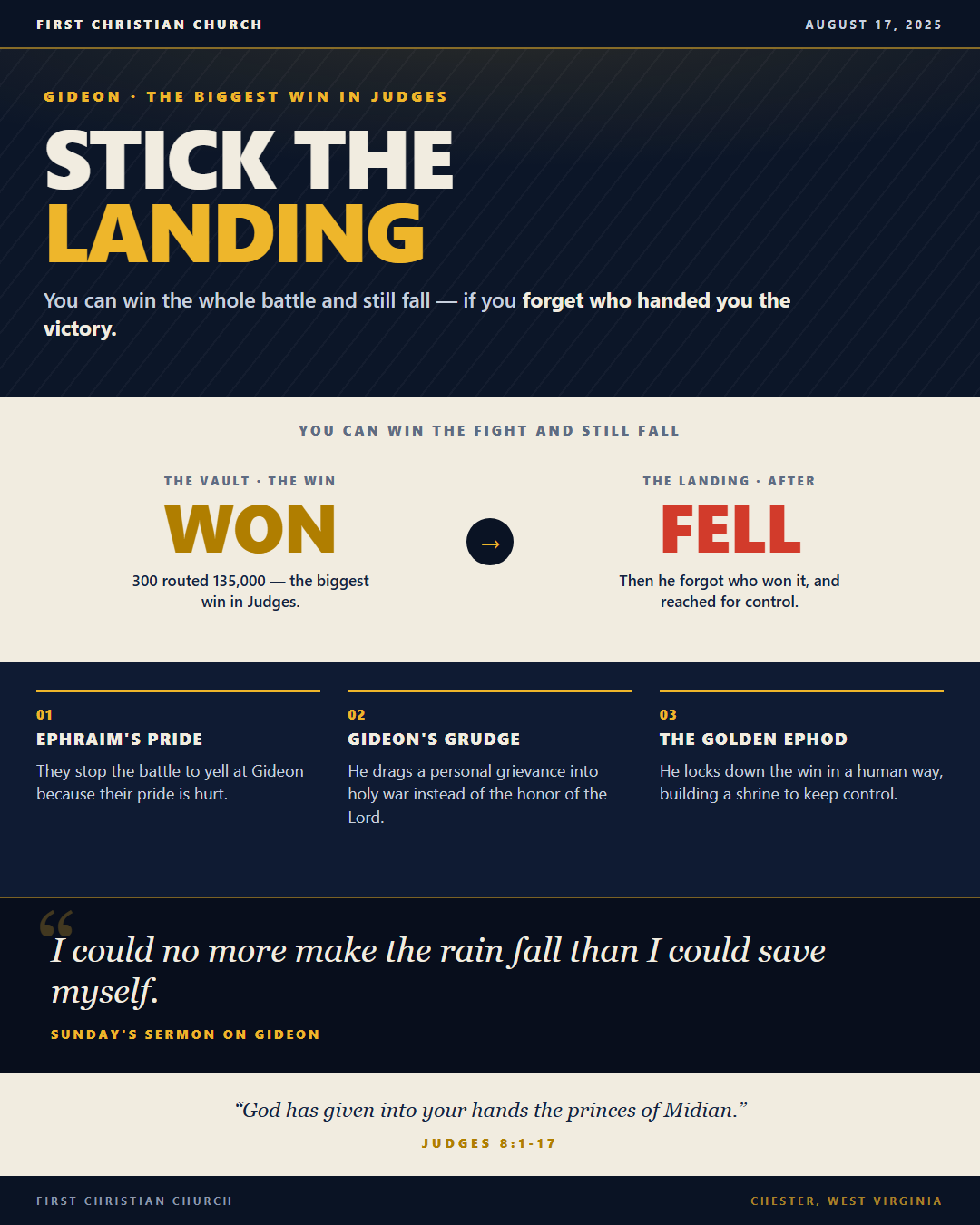
You can do everything right and still blow it after the win — and you blow it the moment you forget that God handed you the victory and start trying to lock it down yourself.
Central Image
McKayla Maroney's vault: a flawless routine only counts if you stick the landing, and Gideon nailed the battle but stumbled all over the dismount through Judges 8.
The Turn
We assume a win means the danger is behind you — Gideon shows the win is exactly where people spin out, because it tempts you to think you're the one who made it happen.
Outline
Gideon, the hinge of Judges
Judges is built with the Gideon story at its conceptual center — everything works toward it and away from it, and Gideon is where the whole book turns from judges who are gung-ho to things going downhill. Last week's win was the biggest in the book: 300 against 135,000, won not by numbers but by the word, "for Yahweh and for Gideon." Midian is one-and-done; they never rise again.
Stick the landing
The victory is enormous — but you've got to stick the landing. You can have everything right, a perfect vault, and if you don't stick the dead-stop landing it doesn't matter. That's the handle for the rest of chapter 8.
The good landing, and the first stumble
Ephraim shows up mid-finish to whine that Gideon didn't call them first — stopping the action to nurse hurt pride while the enemy's still running. Gideon handles them gently ("you guys are so much cooler than me") — that's him sticking the landing. But Succoth and Penuel refuse his exhausted men bread because they're not sure he'll win and don't want to back the wrong side, and Gideon comes back and executes their leaders with thorns and briars for leading their towns into disloyalty.
Off the bubble: Zebah and Zalmunna
Here Gideon really stops sticking the landing. We learn something new — the Midianites had killed his brothers, so this is now personal. He's supposed to kill these kings; it's holy war, like Saul and Agag, not his call to spare them. But the grievance takes over, and he becomes a bad winner. Then he orders his terrified teenage son to execute them — to twist the knife and to set the boy up as a dynasty leader — refusing to give his son the same gentle, baby-step mercy God gave him.
"Rule over us" — who saved you?
Israel asks Gideon to be king, "because you saved us from Midian." Gideon gives the right answer — "I will not rule over you... the LORD will rule over you" — and Toby calls that verse the whole book of Judges. But you can say the right thing and just be saying it: Gideon didn't save them, the Lord did, and they've attributed the victory to the wrong man.
The ephod
Right after the right answer comes the ominous part. Gideon asks for everyone's gold earrings, they spread out a cloak — the exact setup as Aaron and the golden calf — and he makes an ephod, taking a king's cut of the plunder and a king's religious shrine without the title. It's not worshiping other gods; it's worshiping the real God in a humanistic, manipulative way, locking down the win in a human hand instead of remembering whose hand gave it.
Forty years' rest, with the seeds of defeat in it
The land has rest forty years — sounds hunky-dory, except this is the one story where the win already carries its own undoing: Ephraim's pride, cities that don't even believe God will win, and a leader who knows he shouldn't take control but can't stop grabbing for it. The human heart is treacherous, even while it's telling itself it's doing right.
Henry and the baptistry
Last night little Henry came up to be baptized — an unqualified win. But how did it happen? The board's foresight to buy a tub? Revive Fest? His teary-eyed mama? All real factors — and all deadly if you chase the process to force the gift again ("a baptistry ten times as big, ten more next year"). That's building an ephod. Jesus saved the boy; he works through people, so thank the people, but never forget the Giver.
The rain
Then it starts to rain, and that's the sermon: "I could no more make the rain fall than I could save myself, or give myself the victory." We stay faithful, we follow, we do what God calls us to — but the rain comes from above and nowhere else, and when it comes, we're just thankful.
The Landing
Keep your eye on the Giver, not the gift or the process that got it — because the only pedigree any of us has is the blood of Jesus, and there's no shame in being a son who lets his daddy take his hand and raise him up to stand.
Questions to Think About
- Toby said the most impressive thing in gymnastics was always the dead-stop landing — McKayla Maroney's vault was perfect, but he kept pointing at the stick, not the flight. When have you watched somebody do something great and then blow the dismount?
- Chapter 7 is the biggest win in the whole book of Judges — 300 men against 135,000, and Midian never sticks its head up again. Toby said this is the one story where the victory already has "the seeds of defeat" planted in it. Walking back through chapter 8, what were those seeds?
- God baby-stepped Gideon the entire way — called him in the winepress, lit the altar on fire, put up with the fleece twice, gave him an extra sign by letting him overhear a dream. Then Gideon handed his teenage son a sword in the cold light of day and said "kill these men," no warning, no working up to it. What was Toby saying Gideon forgot?
- Toby described the euphoria of a win: "everything I do must be right, everything I do is going to win, everything I do is a great idea." Where has a win in your own life talked you into thinking like that?
- Gideon's logic was "these people are wackos, and the second I stop leaning on them they'll spin out" — so he wouldn't take the title of king but grabbed the king's cut and built the ephod anyway. Where do you reach for control to protect something good you've got, while telling yourself it's for everybody's sake?
- Toby said the ephod wasn't Gideon worshiping other gods — it was Gideon worshiping the real God "in a way that is humanistic and manipulative," something religious he set up so he could stay in charge. What's an ephod you've built that you would never once call idolatry?
- This week's win was little Henry coming up to be baptized. Toby warned us against chasing the process instead of the Giver — "maybe we need a baptistry ten times as big up on the stage and we'll get ten more next year." Where are we, as a church, tempted to copy the setup that "worked" instead of trusting the One who actually saved the boy?
- Toby ended on "who saved you?" — real people contributed, a mama, some songs, a church, but Jesus saved you. This week, name one person God used in your own rescue and actually thank them, out loud or in writing — and name the one thing only Jesus did.