Judges 14:1-20
September 14, 2025
Want to watch instead?This sermon's video
Outline
- The Landing
One question
Toby said a wedding isn't just the bride and groom — it's a "treaty and ceasefire" between two families, and preachers learn to scan the room to see whether the two sides are being friendly or "shooting knives out their eyeballs" at each other. What's a wedding you've been to where you could feel that going on under the surface?
The whole sermon
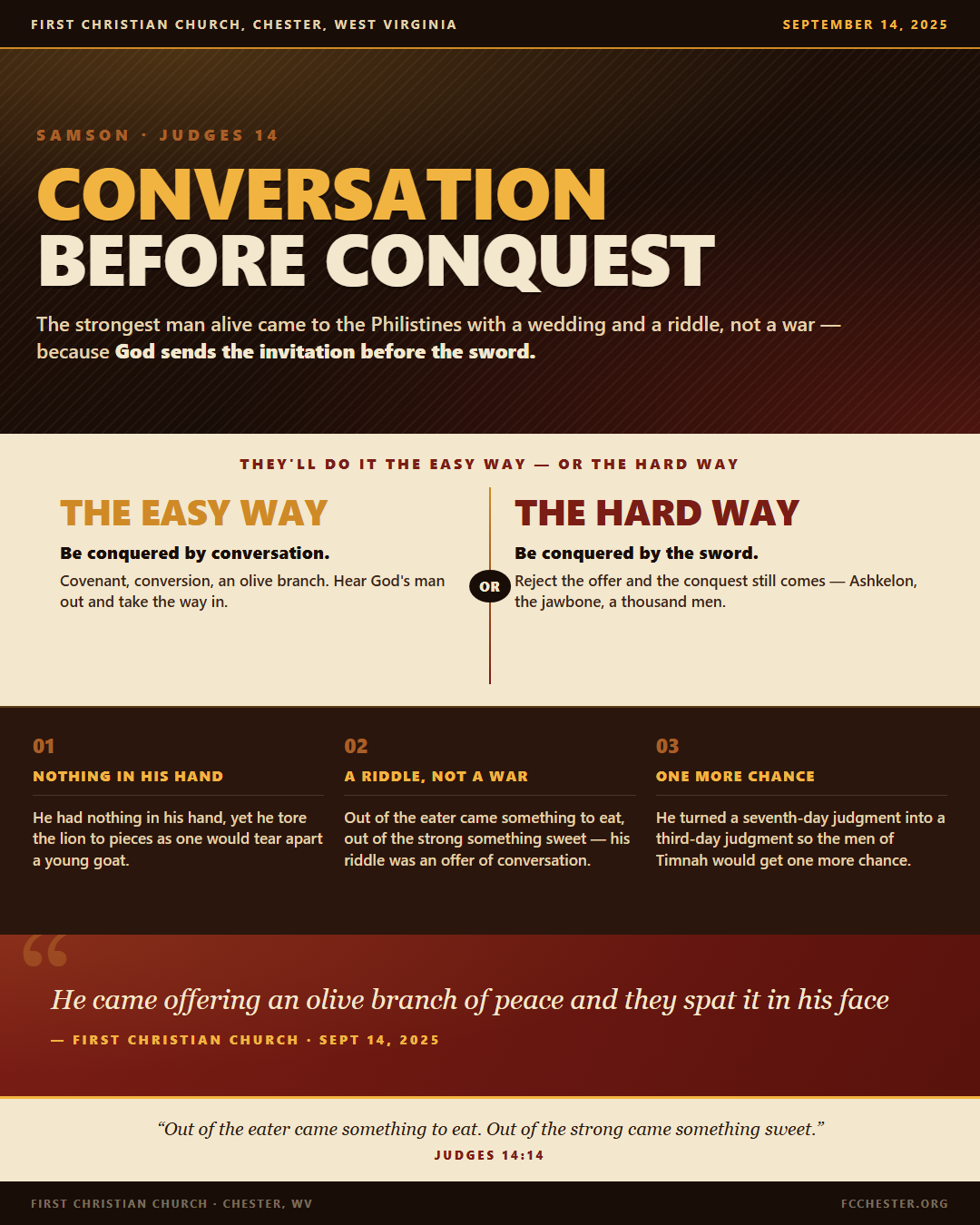
Before Samson threw a single punch he came to the Philistines with a wedding and a riddle — an offer of peace — because that's how God comes to people: the conversation first, and the reckoning only after the offer gets thrown back.
Central Image
Samson walking down into Timnah, a Philistine border town across the line in the sand, carrying not a sword but a wedding and a riddle — an olive branch held out before any fight, standing for the way God approaches even his enemies with an offer first.
The Turn
We read that the Spirit of Yahweh stirred Samson and brace for the lone judge to start the war — and instead he goes looking for a bride, because God's conquest opens with an offer of peace, not a drawn sword.
Outline
The disclaimer, and a seed he doesn't cash in yet
Toby preaches straight through books of the Bible so the text — not his Sunday mood — sets the agenda, and so nobody can accuse him of picking a fight on purpose; it was just the next chapter. He knew a week and a half ago where Judges 14 was headed. And he flagged, almost in passing, that "in God's providence" it turned out "appropriate to the hour" — a seed he leaves buried until the end.
A wedding is an invitation to a conversation
A wedding isn't just the bride and groom; it's a treaty and ceasefire between two families, an invitation into a long conversation some people in the room never wanted to have. In the ancient world a marriage was even more — two houses merging, an economic covenant, the kind of thing that ended wars or toppled dynasties. That frame — wedding as conversation — carries the whole sermon.
We brace for a war and get a wedding
The Spirit stirs Samson, Israel's lone judge against the Philistine bully, and we expect the fight to start. Instead he goes down to Timnah, sees a Philistine woman, and tells his parents, "Get her for me." The deliverer's opening move isn't a sword; it's a wedding — and that's the hinge of the whole thing.
Border towns and a line in the sand
Toby pulled up a map: Philistines on the coastal plain, Israel up in the hills, the Valley of Sorek running between them. Timnah is a border town — they trade across the line, but the archaeology shows a cultural line in the sand, different pottery, different everything. This is why a lost riddle will later feel to them like being "dispossessed": it's contested ground, and Samson is walking down into it.
"An opportunity with regard to the Philistines"
The text says the Lord was "seeking an opportunity," and Toby argued the English Bibles over-translate it "against." Like saying Paul sought an opportunity "with regard to Spain" — you'd assume he's going to preach, not pick a fight. "An opportunity is just an opportunity until we see how the other party receives it." And Philistines were never off-limits for marriage; think covenant, not blood — Rahab's in Jesus' line.
A more careful Samson than you were handed
The lion comes "of lions," the Spirit rushes down, and "he had nothing in his hand" — he tears it apart like a young goat, without a scratch. But he doesn't tell his parents, because they weren't there: a Nazirite who won't even eat a grape walked around the vineyard while they went through it. The honey wasn't unclean either. The reckless, vow-ignoring Samson Toby was always taught doesn't match the text — this is a careful man running "operational security."
The riddle, and the third day they let slip
At a seven-day feast with 30 "groomsmen" (maybe sent to keep an eye on a dangerous man), Samson lays a riddle — the normal way young men peacocked without wrestling — and bets 30 linen garments, a jab at the very thing Philistines prided themselves on. But the riddle is really the conversation: a contest, a relationship, an offer from God's judge. By the third day they can't solve it, and threes run all through this story — a third-day judgment still leaves room to concede and turn. "Maybe these Jews aren't stupid." They don't take it.
The betrayal and the fire she feared
Day four: "Entice your husband, or we burn you and your father's house." The wife doesn't walk the feast bragging that her husband's the cleverest man there; she cries that he must not love her. Toby's read: she feared the Philistines' fire more than she honored God's Savior who was her own husband. Samson knew she'd tell — he'd kept it from his own parents to protect them, not because he distrusted them — and sometimes all you can do is let people go their way.
Ashkelon: a seventh-day judgment turned back to a third
We expect the Spirit to fall and the groomsmen to die like the lion. Instead Samson walks to Ashkelon, kills 30 other men, and pays the debt with their clothes — sparing Timnah. He could have gone through that town like a hot knife through butter (a jawbone and a thousand men are coming next chapter). He doesn't. He turns a finished, seventh-day judgment back into a third-day one: Timnah gets one more chance.
The offer of a conversation comes first
Here's the whole shape: Timnah was going to be conquered by Yahweh's judge no matter what — but they were offered conquest through conversation, conversion, and covenant first, a real good-faith hearing from a clever, faithful man. They clung to their pride and their place and spat on the olive branch. That's the gospel pattern: words first, then the reckoning; every knee bows the easy way or the hard way.
The providence he'd been holding all week
Now the buried seed comes up. Toby planned this a week and a half ago; in between, "the greatest Christian conversationalist of my time" — Charlie Kirk, his friend and mentor — was rejected and murdered, a man who spent his whole adult life having conversations to reach people. Toby's held his grief all week to get through the day. And he won't flinch from the magistrate: family, church, and magistrate are all God-ordained; the church pursues the conversation, and it's no contradiction to expect the government to "not bear the sword in vain." He'll pray for the killer's soul and for his swift execution — "both because I am a Christian."
The Landing
Go and do what Samson did: make the offer first — walk down into the border town with a conversation, the gospel through words — and let it break your heart when it's thrown back instead of refusing to hold it out. And if you already believe, step up and be consistent, because "always" is the most persuasive thing a person can be.
Questions to Think About
- Toby said a wedding isn't just the bride and groom — it's a "treaty and ceasefire" between two families, and preachers learn to scan the room to see whether the two sides are being friendly or "shooting knives out their eyeballs" at each other. What's a wedding you've been to where you could feel that going on under the surface?
- Toby said he'd always been taught Samson was "willy-nilly" about his Nazirite vow — careless, didn't really pay attention to it. Then he pointed at one small detail that flipped that picture: Samson walking around the vineyard while his parents walked straight through it. What did that detail tell Toby about Samson, and what did it overturn?
- When the Spirit of Yahweh rushes on Samson, we expect the 30 groomsmen to end up like the lion. Instead he walks to Ashkelon, kills 30 strangers, and pays the debt with their clothes. Toby said that spared Timnah — "turned a seventh-day judgment into a third-day judgment." What did he mean, and why did it matter that Timnah got one more chance?
- In this story you could be Samson, holding out an offer he knew would probably get thrown back in his face; the wife, who caved to the people threatening her; or Timnah, clinging to their place and spitting on the olive branch. Be honest — which one have you actually been lately, and about what?
- Toby said at every funeral where the family was crazy about the dad, they reach for the same word: "always." "He always, always, always." If the people who live with you had to land on either "always" or "sometimes" about you, which would they honestly pick — and about what?
- Toby said he will pray for the salvation of the man who shot Charlie Kirk and pray that the government executes him as fast as possible — "both because I am a Christian." Do those two prayers actually sit together in you, or does one of them crowd the other out? Which one, and why?
- Toby said the one job the church is specifically on the hook for is pursuing the conversation — the gospel offered through words — before anything else. Honestly: are we a church people experience as still making that offer across the line, or one that's quietly given up on the people on the other side of it? Where would someone see the difference in us?
- The invitation was blunt: become a person who can actually have the conversation. Name one person you've been keeping that conversation away from — the faith one, or the hard one — and decide before you leave the room what your first sentence is and which day this week you'll say it.