1 John 5:13-21
February 1
Want to watch instead?This sermon's video
Outline
- The Landing
One question
Toby said a transaction at Sparkle is a good thing — that gallon of milk costs the same whether the cashier knows you or likes you. Where in your own life are you actually glad something runs like a transaction instead of a relationship?
The whole sermon
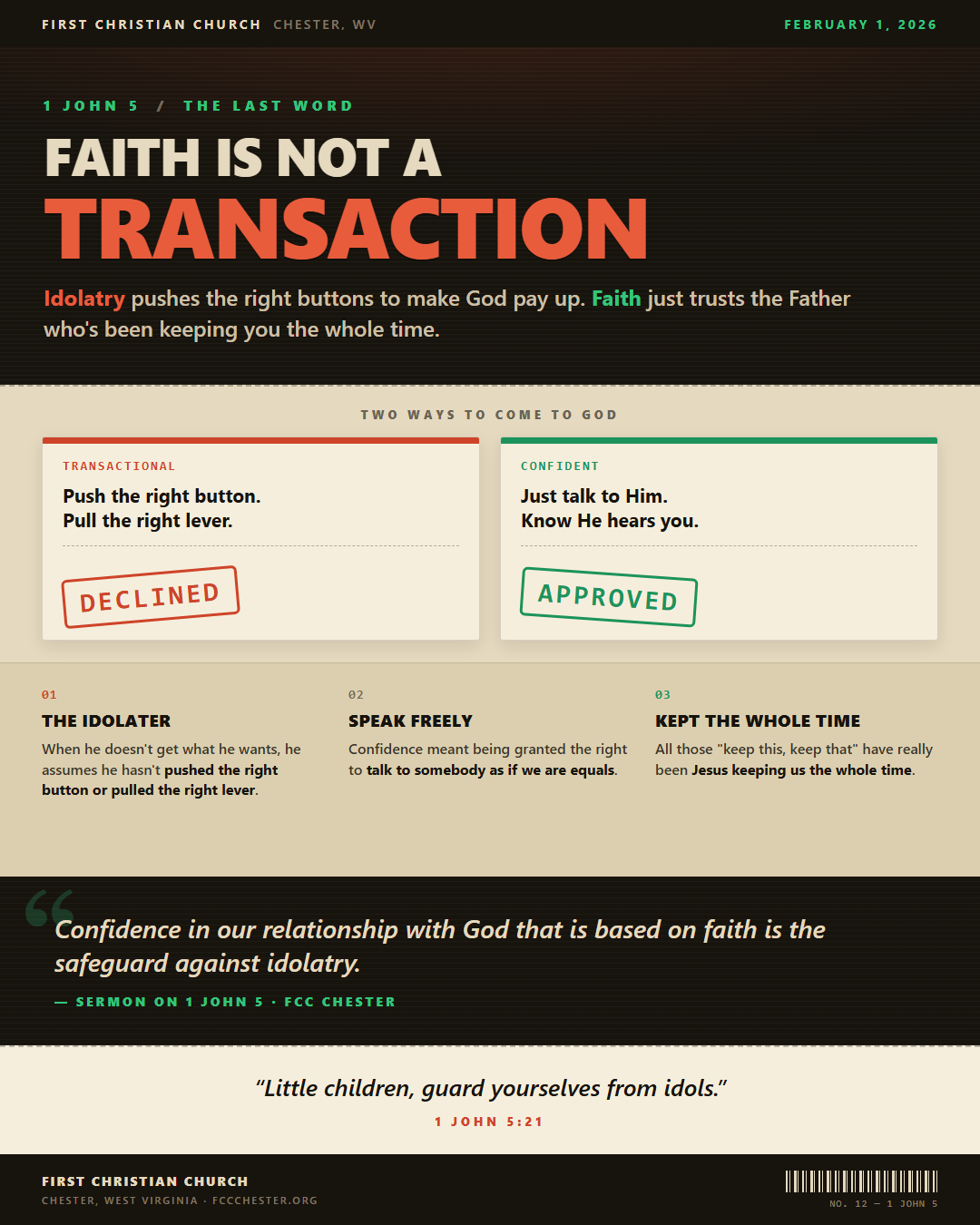
You're not on a payment plan with God — because you're born of God, you already have permission to just walk up and talk to Him, so you never have to buy what you want from Him.
Central Image
The transaction at Sparkle: a gallon of milk that costs the same whether the cashier likes you or not — fine at the register, poison when it's how you treat God.
The Turn
We assume that when we don't get what we want from God we must not have pushed the right button or been earnest enough — but that's the move of an idolater, not a believer, because Jesus has been keeping us the whole time and the relationship was never a transaction.
Outline
Twelve sermons, one job: fertilizer, not poison
John isn't spraying weed-killer to correct people who are wrong; he's spraying fertilizer to strengthen people already on the right track — people who took a hit when others quit Jesus and walked out. Chapter by chapter: hang in there, stay the course, know that you know, turn it up to 11, put it all together. Love means loyalty, not warm fuzzies; we're champions who conquered the world (nike, not "overcame"); the "tests" are really affirmations — Christian DNA, where one bite tells the difference; and the witnesses lock together like Voltron so our unified confession hits harder than any of us alone.
The transaction
Toby names the word: transaction. Go to Sparkle, grab the milk, she scans it, you pay, you leave — mechanical, and it works the same whether she knows you or not. At the store that's exactly what you want. The trouble starts when it becomes how you approach God.
Idolatry is a transaction (the red light district)
The Bible keeps comparing idolatry to prostitution because both are transactional — I do the thing, I give the thing, and now God owes me. The big one: both take something meant to be precious and relational and turn it into manipulation. That's why the letter ends where it does: "little children, guard yourselves from idols" becomes the lens to reread the whole book.
Confidence: permission to speak freely (5:13-15)
In the first century "confidence" meant a lower-ranked soldier's "permission to speak freely, sir" — the right to talk as equals to someone you're not equal to. Born of God, we've been told: permission granted. So "the asks" aren't a magic formula, they're a state of mind — and the person who loses that confidence is the one who starts cutting himself like a priest of Baal to get God's attention.
Sin not to death (5:16-17)
The future tense isn't a command, it's just how it goes: stuff happens, you talk to God, He gives life — no more dramatic than running out of milk. Sin not to death is tripping while you're still headed to Pittsburgh; sin to death is walking the opposite direction entirely, like the folks who left, or praying that Sergio the Satanist would lie less instead of praying he'd come to Jesus — rearranging deck chairs on the Titanic.
The seventh "keep" (5:18-20)
John says the one born of God doesn't keep sinning, but the One born of God keeps him. Six times in this letter "keep" was something we do — keep His commandments, keep His word — and the seventh flips the card face-up: all our keeping was really us being kept by Jesus the whole time.
Guard yourselves from idols (5:21)
Jesus is the true God and eternal life — then the closing punch. Confidence built on faith is the safeguard against idolatry, and we only veer into idolatry when we lose that confidence.
The Landing
Settle it that you're born of God — know that you know that you know — and let that confidence put you on speaking terms with God instead of on a payment plan; then find the little idol still telling you to worry and crush it.
Questions to Think About
- Toby said a transaction at Sparkle is a good thing — that gallon of milk costs the same whether the cashier knows you or likes you. Where in your own life are you actually glad something runs like a transaction instead of a relationship?
- Toby said idolatry and prostitution both take something that's supposed to be precious and relational and turn it into a manipulative transaction. How is that a different picture of idolatry than the statues-and-Greek-gods version most of us grew up picturing?
- "Confidence" in the first century meant being handed permission to speak freely — like the lower-ranked soldier who says "permission to speak freely, sir." What does that add to the word that we'd miss if we just heard "confidence" the normal way?
- Toby described the idolater as the guy who, when he doesn't get what he wants, figures he didn't push the right button, pull the right lever, or wasn't earnest enough — like the priests of Baal cutting themselves. Where have you caught yourself doing a quieter version of that with God?
- At the end Toby told us to find the little idol inside — the one that scratches at you and says you've got to worry, that you can't really trust Him. What does yours say to you?
- Toby said if God tells you no, it's because He wants what's best, like a parent refusing a kid something harmful — but he also said God tells us to keep asking. When you've prayed for something a long time and gotten nothing back, how do you tell trusting God's "no" apart from just talking yourself into peace so it stops hurting?
- Toby said looking down on someone who takes wine instead of grape juice — while they still confess Jesus is the Christ — actually denies 1 John 5:1. Where do we, as a church, quietly draw lines like that between us and people who are on the same road?
- Toby said the normal walk should feel like "we're out of milk, I guess I'll head to Sparkle" — you just talk to God about it and keep moving, no big drama. Name one thing you'd usually spin out over, and actually handle it that way this week.