Philippians 1:1-11
February 15
Want to watch instead?This sermon's video
Outline
- A speech in a letter
- The teaser trailer (vv. 3–11)
- Why Paul's writing
One question
Toby said Paul doesn't open Philippians with an introduction — he opens with a teaser trailer, the way the movies play previews before the feature to get you to buy a ticket for the whole thing. What's a trailer, a first episode, or a free sample that actually hooked you, and what was it about the tease that made you want the rest?
The whole sermon
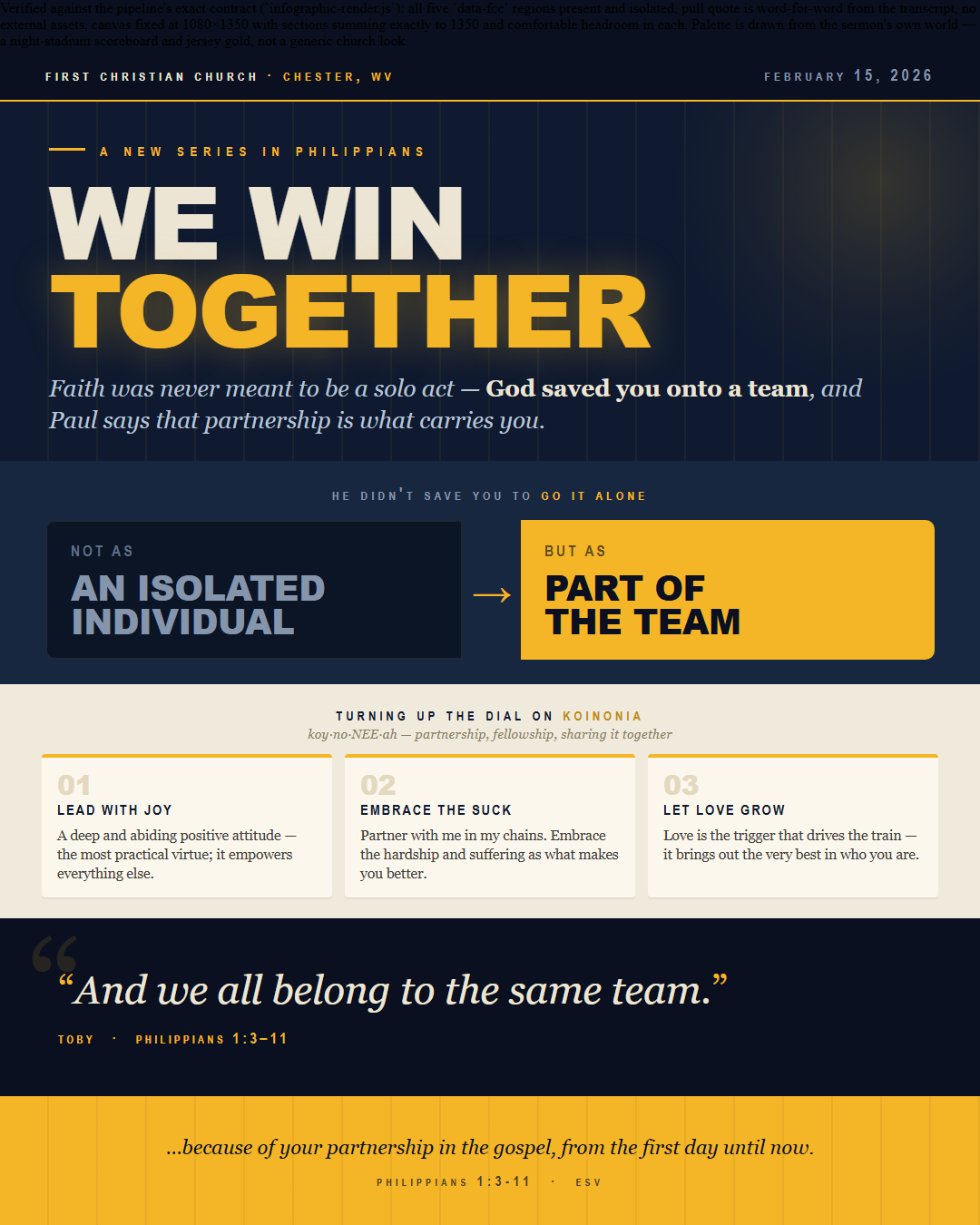
God didn't save you as a solo act — he saved you onto a team, and Philippians is Paul's playbook for turning up the dial on that partnership with Christ and with each other.
Central Image
Four volunteers on stage — two gripping hands while two others try to pull them apart — a picture of koinonia: partners locked together, each one depending on the other not to let go.
The Turn
Baptism isn't something you do to show God your allegiance — it's the uniform he issues you and already paid for, the way a team issues a jersey or the army issues a rifle.
Outline
A speech in a letter
Paul opens with the envelope: slaves of Christ Jesus, to the saints at Philippi with the overseers and deacons, grace and peace. Toby's point — every New Testament document was a speech meant to be heard out loud first and read second. The run-ons and the heat are features, not flaws; you're supposed to hear a fired-up speaker, not scan a textbook. From verse 3 on, it's a speech.
The teaser trailer (vv. 3–11)
These verses aren't an introduction — they're coming attractions. Paul throws out themes he won't flesh out yet, leaves you hanging, and makes you want the whole letter. You're not meant to mine everything out of them; you're meant to get interested enough to keep listening.
Why Paul's writing
He's under house arrest in Rome, chained to a soldier, unable to work — and Rome didn't feed its prisoners. The Philippians heard about it and sent a serious financial gift so he could eat. The letter is partly a thank-you, and that gift is the very partnership he's about to build on.
Koinonia
Four volunteers, the whole room saying the word, and the hand-grip demo. Koinonia means partnership, fellowship, things held in common — the word sitting under almost every "communion," "fellowship," and "partner" term in the New Testament. It's the anchor of Philippians because these people partnered with Paul in his chains and in the gospel. Paul thinks they're already a championship team; he wants to take them up a level.
Dial one — Joy
Love is the highest virtue, but joy is the most practical. Joy is a deep, abiding positive attitude grounded in a God who is all-powerful, merciful, and working everything for your good because he's called you his child. A bad attitude sabotages any partnership — Toby owns having been that guy — so joy empowers everything else, and that's why Paul leads with it.
Dial two — Embrace the suck
"Partner with me in my chains." Paul beat the special forces to "embrace the suck" — take the hardship as the process that makes you better. Christ, who was the very nature of God, didn't grasp at equality but made himself nothing; embrace that humility and suffering. And this step only works if the joy is already underneath it.
Dial three — Love that grows into knowledge
Paul prays their love grows more and more in knowledge and insight, so they can bring out the very best of what's in them. Love is the forge — it's what lets you see what's best in you and bring it to the table. When the partners actually care about each other winning, they start working out how to grip stronger. Love is the trigger that drives the train.
We win together
All three dials strengthen one thing: the partnership. We win as partners — with Jesus Christ and with one another — and the whole letter is Paul turning that dial up.
The uniform
One more thing, not in the text but true: a team wears a uniform. Show up to the game in street clothes against a squad in matching jerseys and you already know how the day goes. Christianity has exactly two rituals — baptism and communion — and both strengthen the partnership. Baptism is the uniform, issued the way an NFL team issues a jersey or the army issues a rifle. It isn't something you do to show your allegiance; God issues it, and he paid for it. If you believe and haven't taken it, quit treating it as optional.
The Landing
Let God use Philippians to fan the flame of your joy, your love, and your knowledge so the partnership gets stronger — and if you believe but have never put on the uniform, stop calling baptism optional and take what's already been issued to you. The door to come to Christ for the first time stands open too.
Questions to Think About
- Toby said Paul doesn't open Philippians with an introduction — he opens with a teaser trailer, the way the movies play previews before the feature to get you to buy a ticket for the whole thing. What's a trailer, a first episode, or a free sample that actually hooked you, and what was it about the tease that made you want the rest?
- The whole middle of the sermon hung on one word: koinonia. Four people on stage, two gripping hands and two trying to pull them apart. What did that hand-grip actually show about what partnership means — and what did it show happens the moment one person decides to let go?
- Toby insisted joy comes first, and called it the most practical virtue, not the softest one. Why would joy — "a deep and abiding positive attitude grounded in something bigger than circumstance" — be the thing that makes everything else in the partnership possible?
- Toby admitted he's been the guy with the lousy attitude on a project. Where are you carrying a lousy attitude right now into something you're supposed to be partnering on, and what excuse to quit is it quietly handing you?
- Paul writes "partner with me in my chains" and tells them to embrace the hardship as the process that makes them better. What's something hard in front of you that you've been trying to wriggle out of instead of embracing?
- Toby grounded joy in the promise that God orders everything for your ultimate good — and then kept moving. When the suffering is real and nothing feels like it's working for your good, is that "deep and abiding positive attitude" still honest, or does it start to tip into pretending? Where have you felt that gap?
- Toby said we're saved onto a team, not as isolated individuals, and Paul wants the dial turned all the way up on our partnership. Where is First Christian gripping tight together right now, and where are we holding on loose?
- The Philippians didn't just feel close to Paul — they sent money so he could literally eat while he was chained up in Rome. Who in this church needs something concrete from you this week, and what will you actually get into their hands before next Sunday?