Philippians 4:10-23
May 3
Want to watch instead?This sermon's video
Outline
- The Landing
One question
Toby said we've all known somebody we wouldn't let buy us a Coke, because we could feel the hook coming. Who did you think of when he said that — and how did you know the hook was there?
The whole sermon
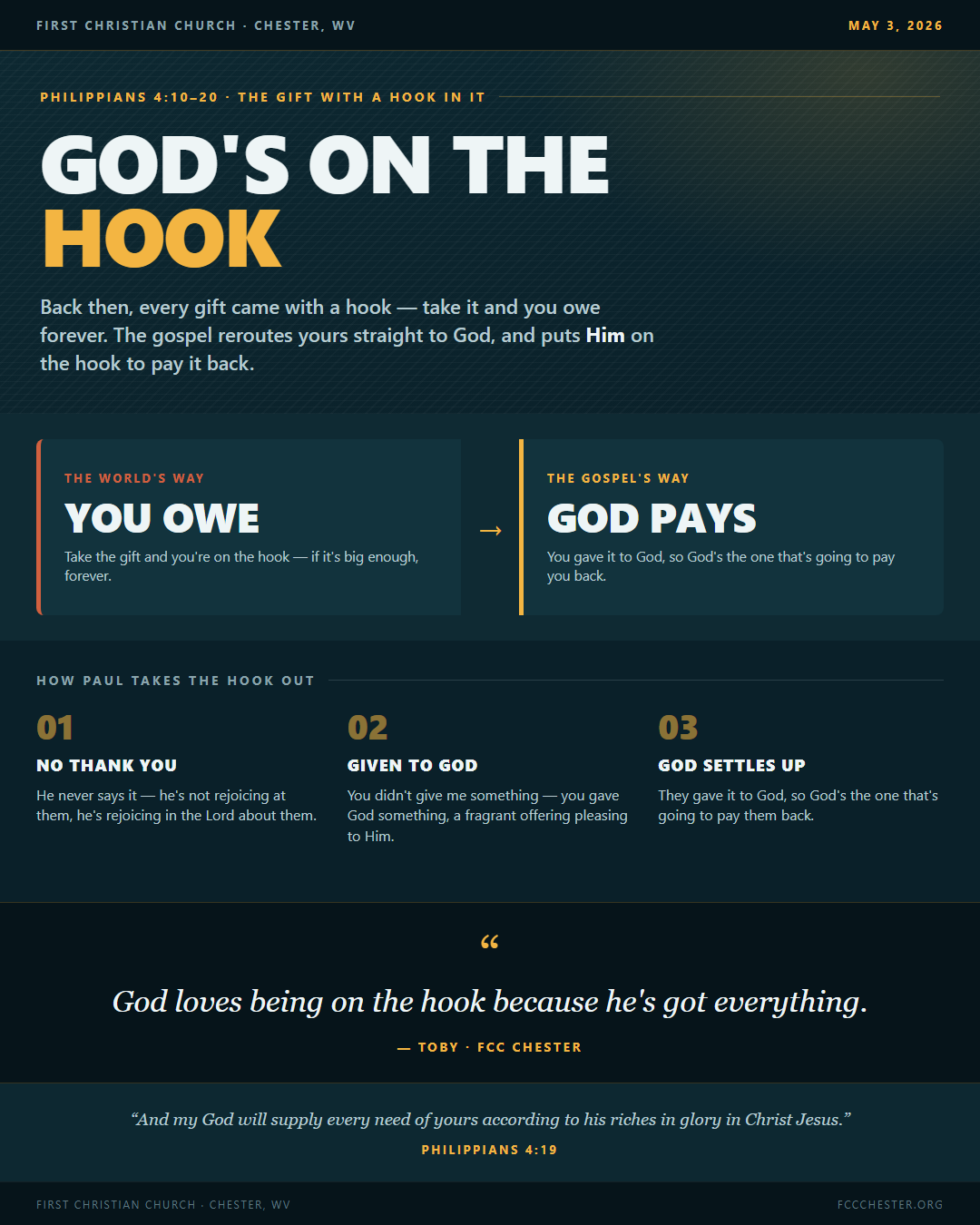
Whatever you give isn't really going to a person or a project — it goes straight to God as an offering, and God is the one who pays you back.
Central Image
The gift with a hook in it — pictured by Toby's most expensive shirt, bought not with his money but with a wealthy member's $500 gift card — standing for every gift that leaves you quietly owing the giver.
The Turn
We assume a gift puts you on the hook to pay the giver back, and a big enough gift hooks you forever; Paul shows that when the gift is routed to God, God takes the hook — and God can afford it.
Outline
The shirt with someone else's money on it
Toby wore his most expensive shirt — 20 years old, bought with a $500 gift card a wealthy member handed him at Christmas, not with his own money. It set up the one idea the whole sermon hangs on: some gifts come with a hook in it, the kind where you walk away owing. We've all known people we wouldn't even let buy us a Coke, for exactly that reason.
In Paul's world, every gift had a hook
Reciprocity wasn't rudeness, it was the air they breathed — a fish doesn't know the water's wet — and it governed daily life as much as your credit score governs yours. Take a gift, say thank you, and you'd taken the hook; a big enough gift hooked you forever. So when the Philippians sent a large gift, Paul had to write a thank-you note without ever saying thank you — to stay off the hook, and to keep from training good people that this is how giving works.
Watch what Paul does instead of saying thanks (Philippians 4:10–23)
He rejoices in the Lord — not at them, not even in them, but in the Lord about them — because the gospel reroutes everything to God. Then he backs off fast: he's not in need, not hinting for more, not running the preacher move of thanking you into giving again.
The secret: "I'm up for anything through the One who empowers me"
Not positive thinking ("I can be an NFL linebacker"), but this: if God calls you to it, He supplies the power for it — poor, rich, a Roman jail, the Areopagus, Spain. And sometimes the assignment is just to hold on right where you are. Toby pointed to Jesus telling a church in Revelation to simply keep what they had — the thing no preacher says, because they always want one more thing out of you.
"You boys did good" — honor without the hook
Paul reaches back to koinonia from the start of the letter: they didn't just send money, they partnered in his tribulation, same as they'd done clear back in Thessalonica. Then he slides into ledger language — "to your account," "payment in full," "overflowing" — jarring in their world, where a thank-you was the expected move.
The gift becomes an offering to God
Paul lifts their gift higher than thanks ever could: a fragrant offering, an acceptable sacrifice, pleasing to God. You didn't give Paul something, he says — you gave God something, and the Apostle Paul declaring God pleased with you carries weight no thank-you note could.
Turning the hook inside out
A gift means you pay back; a big one means forever — so Paul hands the whole thing to God: you gave it to God, and God will supply your every need out of His riches. God's on the hook now, not Paul, and God loves being on the hook because He can cover it. Then the kicker — greet the saints "of Caesar's house": Paul, under guard, converting Caesar's own household out from under him.
Audience of one
Paul reroutes not just money but time, sweat, and work — all of it goes to God, so it all means more than we thought. Toby told on himself: as a young youth minister he caught the thought that he'd have prepped harder with a big name in the pew — until he asked who he figured was listening every other Sunday. The one grading it is the Lord. Like what you do, enjoy the attaboy, but don't do it for the attaboy — want the Lord's.
The Landing
Lay it all out for the Lord with no hooks on anybody, giving and serving for an audience of one instead of the pat on the head. Like a Steeler who could ride the bench and still wear the ring — you've already got the ring, but God loves to see you actually get in the game and play.
Questions to Think About
- Toby said we've all known somebody we wouldn't let buy us a Coke, because we could feel the hook coming. Who did you think of when he said that — and how did you know the hook was there?
- Once you know that in Paul's world saying "thank you" for a big gift meant you'd taken the hook and now owed the giver back, how does that change the way you hear the end of Philippians?
- Paul flips the whole thing by saying God — not Paul — will supply their every need, so God is the one who owes them now. Why does handing the debt to God get Paul off the hook instead of just moving the hook somewhere else?
- Paul said he had to learn how to be rich and how to be humble, and that plenty of people can only manage one. Which one are you worse at — and what does being bad at it actually look like for you?
- Toby admitted the thought crossed his mind that he'd have worked harder on his sermon if a big name had been sitting in the pew. Where do you do your best work only when the right person is watching?
- Toby said sometimes God's whole assignment is to just hold on right where you are — but he also said sometimes "I'm not doing enough" is really us wishing God had handed us a different assignment. How do you tell those two apart in your own life?
- Toby wants us to be a church with no hooks — nobody getting hooked and nobody setting hooks. Where do hooks quietly show up in how we give and serve around here, even when no one means to set one?
- Pick one thing this week — an hour, some money, a job that needs doing — and do it where no one will ever find out it was you, aimed at the audience of one. What's the thing?