1 Corinthians 2:1-16
October 4
Want to watch instead?This sermon's video
Outline
- The crossword that got a man arrested for treason
- The real question: how could Paul possibly know this? (2:1-5)
- The Greek way, and the wisdom that expires (2:6-8)
One question
Toby talked about getting put on the spot — somebody asks you something simple and your mind goes blank, like you're under the heat lamp getting the third degree. When's a time that happened to you, even when you had nothing to hide?
The whole sermon
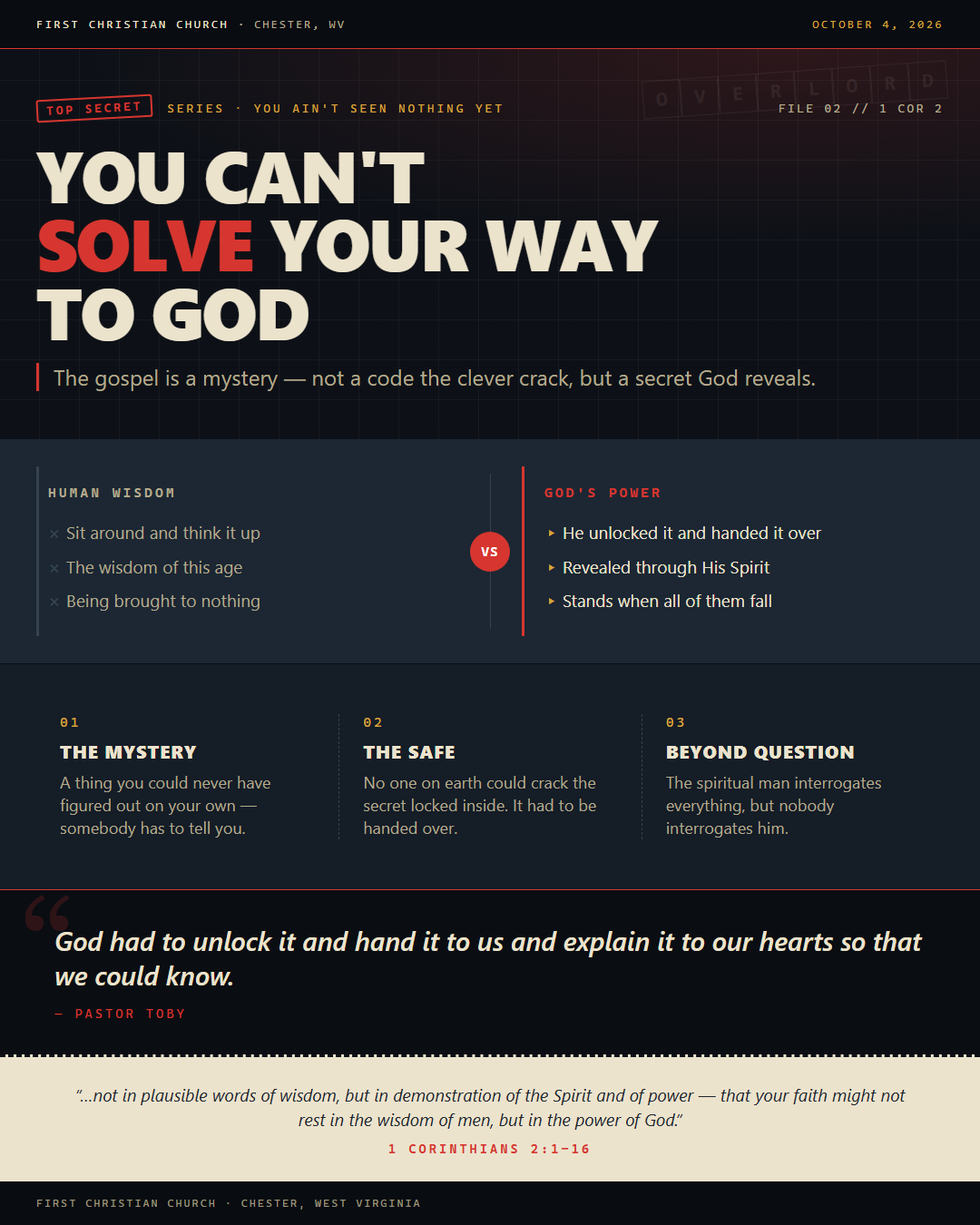
Nobody reasons their way to Jesus — God unlocks it and hands it over — so the plain fact that you believe at all is proof the Spirit already did something in you.
Central Image
A locked safe with the next ten Super Bowl champions sealed inside in code: no expert can crack it by thinking harder — the owner has to open it and translate the paper — and that's the gospel, with Jesus as the paper and the Spirit as the translation.
The Turn
We assume you have to be smart enough to figure the big things out, and that if you can't win the argument your faith doesn't count — Paul says it was never yours to figure out, it was handed to you, which is exactly why no interrogation can take it from you.
Outline
The crossword that got a man arrested for treason
Leonard Dawe — 1912 Olympic footballer, headmaster, and the man who made the Daily Telegraph crossword — got snatched by MI5 in June 1944 and worked over until he felt "turned inside out." The reason: the top-secret code words for D-Day — Utah, Omaha, Overlord, Mulberry, Neptune — kept showing up in his puzzle. Turned out his students had overheard soldiers camped by the school fence and fed him the "cool words"; it was a dumb coincidence. But when the feds come knocking they don't assume you're innocent — and somehow this ordinary man was holding the biggest secret on earth.
The real question: how could Paul possibly know this? (2:1-5)
Toby turns Dawe's interrogation into Paul's — how can one guy claim to know the most important thing there is? The Corinthians are busy fighting over whose preacher is snazzier. Paul says he never played that game: he came in weakness and trembling, "decided to know nothing among you except Jesus Christ and him crucified," so their faith would stand on God's power and not a good speech.
The Greek way, and the wisdom that expires (2:6-8)
The Greeks were sure you reach anything important by sitting around thinking hard enough until you suss it out — good for geometry, less good for Greek yogurt. Paul says what he carries isn't "the wisdom of this age," and every age's wisdom eventually expires. Exhibit A: the two smartest men Toby knew once patted him on the head — "Toby, there will never be a self-driving car." God's wisdom was laid down before the ages and still stands when every fashion has fallen into the dust.
"You ain't seen nothing yet" (2:9-10)
"What no eye has seen, no ear has heard" — everybody quotes it about heaven and the sweet by-and-by. Paul isn't talking about the future; he's talking about what God has already done: became a man, was crucified for our sins, rose, and poured out his Spirit so we could be his children. Nobody saw it coming and nobody could have figured it out — which is the whole point of the series title.
What "mystery" actually means — the safe (2:11-13)
Not Scooby-Doo spooky. For Paul a mystery is something you could never figure out on your own; somebody has to hand it to you. Picture a locked safe with the next ten Super Bowl champions inside — every expert alive could talk around it forever and never crack it; only the owner can open it, and even then the list is in code he has to translate. Jesus is the paper in the safe; the Spirit does the translating. That's why it's not wisdom — it had to be revealed.
Beyond interrogation — "Dad said so" (2:14-16)
Paul's word for "examined" also means "interrogated" — so the natural man can't make heads or tails of it, but the spiritual man examines everything and gets interrogated by no one. Mic drop. If you reasoned your way to something it's always up for question; but if someone who actually knows handed it to you, all you have to say is "he told me," the way a kid ends every argument with "Dad said so." We have the mind of Christ, so the snazzier preacher was never the point.
The Landing
Take the very fact that you believe Jesus is who he says he is as a sign of God's kindness to you — the natural man can't receive it, so believing it at all means the Spirit already did something wonderful in you. Let your confidence rest there instead of on having every answer, and then say it plainly to someone: you believe because eyewitnesses who would never die for a lie told you, and God confirmed it in your heart.
Questions to Think About
- Toby talked about getting put on the spot — somebody asks you something simple and your mind goes blank, like you're under the heat lamp getting the third degree. When's a time that happened to you, even when you had nothing to hide?
- When Paul got to Corinth he could've tried to out-talk everybody, but he said he "decided to know nothing among you except Jesus Christ and him crucified." Why would he strip it down like that on purpose?
- In the safe illustration, the sharpest sports guys alive still couldn't name the champions locked inside — only the owner could open it and translate the code. What did Toby say the safe, the paper, and the translation each stand for?
- Toby said the fact that you believe Jesus is who he says he is — that itself is proof God already did something in you. Does your faith feel like a gift that got handed to you, or like something you worked out and now have to keep defending?
- When somebody hits you with "who do you think you are to say your way is right and mine's wrong," what actually happens in you?
- Toby's answer to the skeptic was basically "he told me — go ask him," like a kid saying "Dad said so." But somebody in another religion could say the Spirit confirmed their thing in their heart too. What keeps "Dad said so" from just being a way to stop thinking?
- Paul told a divided church that God hands the truth to people by his Spirit, not through the most impressive guy up front. Where do we still quietly rank each other around here by who seems more impressive or more sure of themselves?
- This week, pick one person whose "who do you think you are" question has stuck with you, and go back to them — not to win, but to say the plain version: "I believe because people who were there told me, and it landed on my heart." Who's that person?